Book in March & Save 10% on Any Tour

The Regency Era
Discover what the Regency era was and how the Prince Regent shaped fashion, architecture, and London during the early 19th century.
3/10/20262 min read
What was the Regency era?
With the popularity gained by TV series like Bridgerton and new adaptations of Jane Austen’s novels, you've probably heard mentions of the Regency era, Regency novels, or Regency romance. But why are they called Regency?
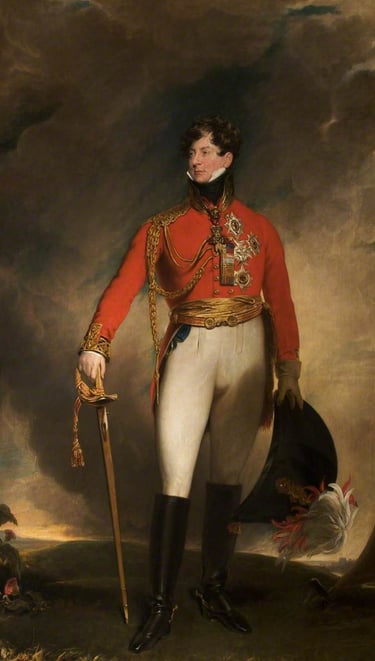
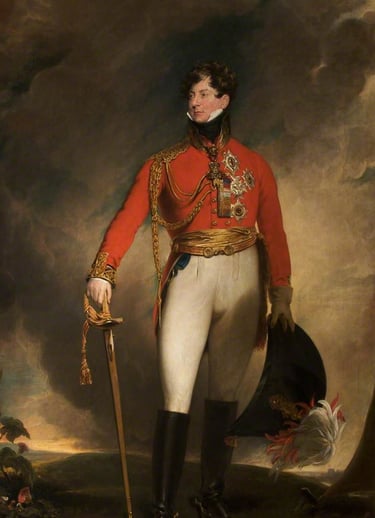
The Regency era was a period in early 19th-century Britain (1811–1820) when George III was deemed unfit to rule because of mental illness. His eldest son, George IV, ruled in his place as Prince Regent, giving his title to the era that followed.
Although relatively short, the Regency period had a lasting influence on British culture and is often remembered for its distinctive fashion, elegant architecture, literary works, and vibrant social life.
The Prince Regent and his influence on fashion
The Regency era is well known for its achievements in fashion, the arts, and architecture, but it was also marked by extravagance and excess, reflecting the personality of the Prince Regent himself.
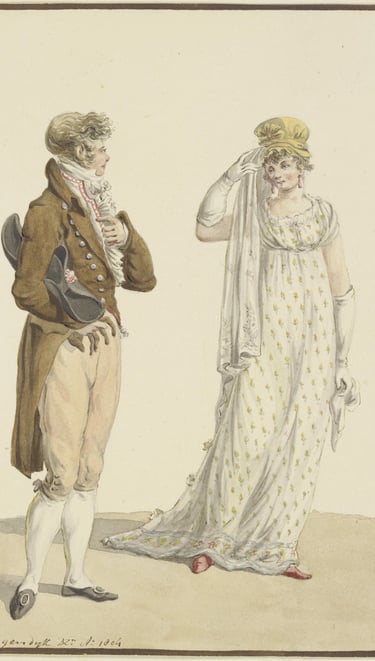
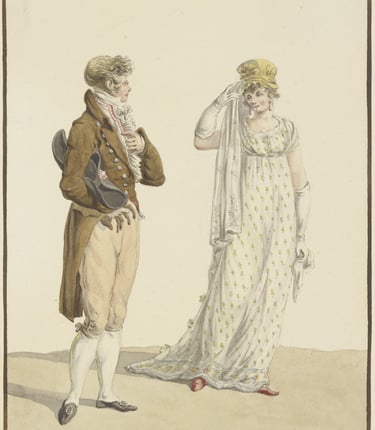
He influenced men’s fashion in several ways. When his political opponents, the Tory Party, introduced a tax on wig powder to help fund the Napoleonic Wars, George decided to wear his hair naturally instead of wearing powdered wigs.
He also began wearing darker colours than had previously been fashionable, along with looser trousers to hide his increasing size (by the time he became king he was already obese). High collars worn with neck cloths also became fashionable, partly because they helped hide his double chin.
Regency fashion for women
Women’s Regency fashion was heavily influenced by neoclassical Greek and Roman ideals.
Dresses were made of light muslin fabrics with empire waistlines and low necklines, following the natural lines of the body to create a light, flowing drapery. The aim was to recreate the appearance of classical statues with a column-like silhouette.
This elegant style replaced the stiff corsets and heavy structures of 18th-century fashion, creating the iconic Regency look often seen in period dramas today.
How the Regency era shaped London
The Prince Regent was also an important patron of the arts and had a strong interest in architecture. He hired the architect John Nash for several major projects that transformed the appearance of London.
Among the most famous developments from this period are Regent's Park, Regent Street, Carlton House Terrace, and the Haymarket Theatre. These landmarks remain an important part of Regency London and can still be visited today.
A controversial Prince
Despite his cultural influence, the Prince Regent was not particularly popular with the public. Many people criticised the enormous debts he accumulated through lavish banquets, fashion, and ambitious architectural projects.
His personal life also caused scandal. He treated his wife, Caroline of Brunswick, poorly, had several mistresses, and even refused to recognise her as queen.
Why the Regency era still fascinates us
Today the Regency era continues to fascinate historians, readers, and visitors alike. From elegant fashions and glittering social seasons to political scandals and architectural transformation, it was a short but remarkably influential period in British history.
Walking through parts of London today, you can still see the legacy of the Prince Regent and the world that inspired the novels of Jane Austen and the Regency stories loved by modern audiences. If you'd like to discover this world for yourself, join me on a private Regency London walking tour through Mayfair, St James's, Hyde Park and Covent Garden.